
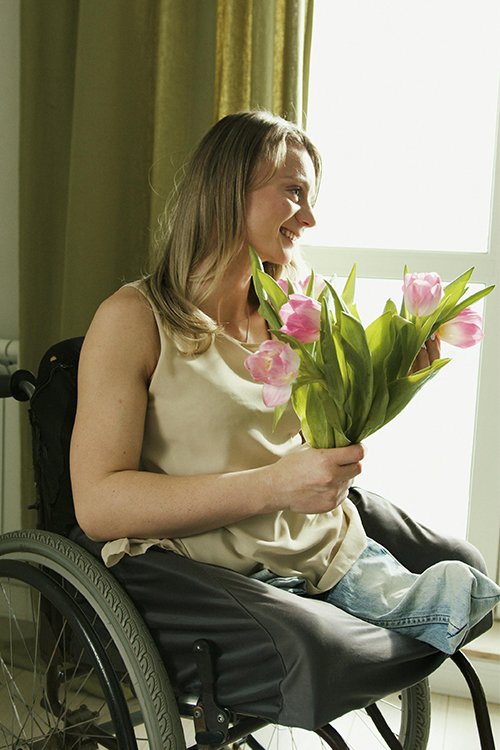

The truth is that “disability” is not one thing – it is thousands of very specific bodies, brains and lives. When we talk about sex and pleasure, that specificity really matters. Instead of asking “Can disabled people have sex?”, a better set of questions might be:
- What does sex look like for someone who uses a wheelchair?
- What changes when you live with chronic pain or fatigue?
- How do neurodivergent or cognitively disabled people navigate consent and desire?
There are no universal answers, but there are patterns, tools, and scripts that can make sex safer, kinder, and more pleasurable for many of us.
Consent, Care and Power: The Hard Conversations
One topic that often gets skipped is power. Many disabled people depend on others for daily care—transferring, bathing, dressing, feeding, managing meds. Sometimes that caregiver is also a romantic or sexual partner; sometimes it is a professional. Either way, the dynamic is not “equal strangers on a first date.” That doesn’t mean care and kink—or care and romance—can never mix. It does mean we need extra-clear guardrails.
Some questions that can help clarify things:
- If this person stopped caring for me tomorrow, would I still want them as a lover or partner?
- Do I ever feel like I “owe” sex because someone helps me with basic needs?
- Do I feel safe saying “no,” “not now,” or “never again”—and having that respected without punishment?
If your answer to any of these feels shaky, it can be useful to:
- Write down what is always okay, sometimes okay, and never okay.
- Agree on a clear “stop signal” that works for your body and communication style—this could be a word, a hand tap, a toy dropped to the floor, or sending a specific text.
- Bring a trusted third party (friend, therapist, peer support) into the conversation if power feels really unbalanced.
Consent is not a legal form you sign once; it is a living, ongoing negotiation that should feel flexible, safe, and reversible.
Talking to Doctors About Sex (Without Apologizing)
Medical systems are notoriously bad at treating disabled patients as sexual beings. Many of us have heard some version of “You should be grateful you’re alive—why are you asking about sex?” or “People like you don’t usually have those concerns.”
You are allowed to care about pleasure. You are allowed to ask how medications, surgeries, or devices will affect your libido, erections, lubrication, orgasms, or sensations.
Practical tips for medical conversations:
- Go in with a short list (3–5 bullets) of what you want to ask: “Will this medication affect my erection?” “Is it safe for me to have penetrative sex in these positions?” “What can I use if I have pain with penetration?”
- Use neutral, direct language: penis, vulva, vagina, rectum, erection, orgasm, lube. Slang can be fun in bed, but clarity helps in clinics.
- If a provider laughs it off, shames you, or refuses to answer, you are allowed to say: “This matters to my quality of life. If you can’t help, can you refer me to someone who can?”
You never have to choose between being “a compliant patient” and “a sexual person.” You are both.
Beyond Penetration: Rethinking What “Counts” as Sex
Many disabled people grow up believing “real sex” means penis-in-vagina in one or two standard positions with both bodies moving in a very specific way. For a lot of us, that model is physically painful, exhausting, dangerous—or simply boring. Expanding the definition of sex can be radically liberating:
- Oral sex, hand sex, sex toys, mutual masturbation.
- Erotic massage, temperature play, gentle bondage, sensation play with feathers, fabrics, vibration.
- Kissing, grinding, using pillows or wedges to support bodies in ways that feel sustainable.
One useful starting question for partners is: “If we take penetration off the table for tonight, what kinds of touch or play would feel hot, comforting, or exciting?” Removing the pressure of “performing” a specific script often opens space for creativity that is far more accessible to disabled bodies.
Practical Positioning and Fatigue Hacks
You do not need circus-level strength or flexibility to have satisfying sex. What you do need is honesty about what your body can and cannot do for long. A few general ideas (to be adapted for your body and mobility):
- Shorter sessions, more often: Instead of one marathon hour that leaves you wiped for two days, try 10–20 minute windows with rest and cuddling built in.
- Surfaces matter: A firm bed, a couch with armrests, a reclining chair, or a wheelchair with brakes on and leg rests adjusted—all change which positions are possible.
- Pillows, wedges, and rolled towels are disability-friendly “sex gear.” They can support hips, knees, backs, and help you stay in a position without constant muscle effort.
You and your partner can treat this like an experiment: try one position or setup at a time, check in after a few minutes, and adjust. Less drama, more curiosity.
When Pain, Spasms or Medical Devices Are in the Bedroom
For many disabled people, chronic pain, spasms, catheters, ostomy bags, braces, ventilators, or seizure risk are simply part of the sexual landscape. Ignoring them rarely makes sex better; planning around them often does.
Some principles:
- Name the elephant: “My catheter/ostomy/brace is here. Here’s what you can and can’t touch. If it hurts or pulls, I’ll tell you and we’ll stop.”
- Position around devices: Sometimes that means keeping a certain side up, using extra padding, or choosing positions where tubes and wires are visible and not compressed.
- Have a “who does what if X happens” plan: If there is a risk of spasms, dislocation, or seizures, calmly agree in advance about what the partner should do—stop, ground, call for help, administer meds, etc.
This doesn’t have to suck the joy out of sex. Think of it as the safety briefing before a roller coaster: a few minutes of planning to make the ride more fun, not less.
For Non-Disabled Partners: How Not to Be Weird About It
If you are the non-disabled partner, you hold a lot of power—even if you don’t mean to. Your curiosity, awkwardness, arousal, and fear are normal. What you do with them is what counts.
A few principles:
- Don’t pretend the disability doesn’t exist. Saying “I don’t even see your wheelchair” sounds like you’re ignoring a real part of your partner’s life and body.
- Don’t turn your partner into a fetish or a saint. “You’re so inspiring” is not usually a sexy opener. “I’ve always wanted to try sex with someone in a wheelchair” turns them into an object.
- Ask specific, practical questions instead of vague ones: “What positions feel good and safe?” “Is there anything I should avoid touching?” “How will I know if you need a break?”
You can also explicitly invite honesty:
- “If I do something that doesn’t work for your body, I want you to tell me, even if it feels a bit awkward.”
- “We can take this one step at a time. We don’t have to do everything tonight.”
Your job is not to “fix” or “heal” your partner. Your job is to co-create a shared erotic language that fits both of your bodies.
Shame, Body Image and Reclaiming Desire
Many disabled people have been told—directly or indirectly—that we are undesirable, broken, too much work, too fragile, too dependent. Those messages do not evaporate just because we read one sex-positive blog post.
Some ways to work against that internalized crap:
- Curate your feed: Follow disabled creators, models, writers, and activists who talk openly about sex, pleasure, and disability. Seeing bodies like yours desired and desiring is political medicine.
- Practice erotic self-touch that is not only goal-oriented. Instead of “I have to get off,” try “I want to learn what kinds of touch, smell, sound, and fantasy make my body feel alive.”
- Let yourself grieve what has changed. If your body works differently after injury, illness, or surgery, it’s okay to miss how things were and be curious about what’s still possible.
Desire is not a limited resource that only belongs to a narrow category of “perfect” bodies. Your disabled body is not waiting to become acceptable; it is already a legitimate site of pleasure.
Building Your Own Disabled Pleasure Toolkit
There is no single “right” way to be a disabled sexual being. But you can slowly build your own toolkit of questions, supports, and practices that feel realistic for you. You might ask yourself:
- What does “good sex” mean for me now—emotionally, physically, relationally?
- What do I need to feel safe enough to relax and be curious?
- Which tools—from medication timing to positioning aids, toys, or scripts for talking—are worth experimenting with?
Start small. Choose one conversation, one position, one toy, one self-touch session, one new boundary. Notice what shifts. Adjust.
Your body has already survived and adapted in ways many people cannot imagine. It deserves sex and pleasure that adapt with it.